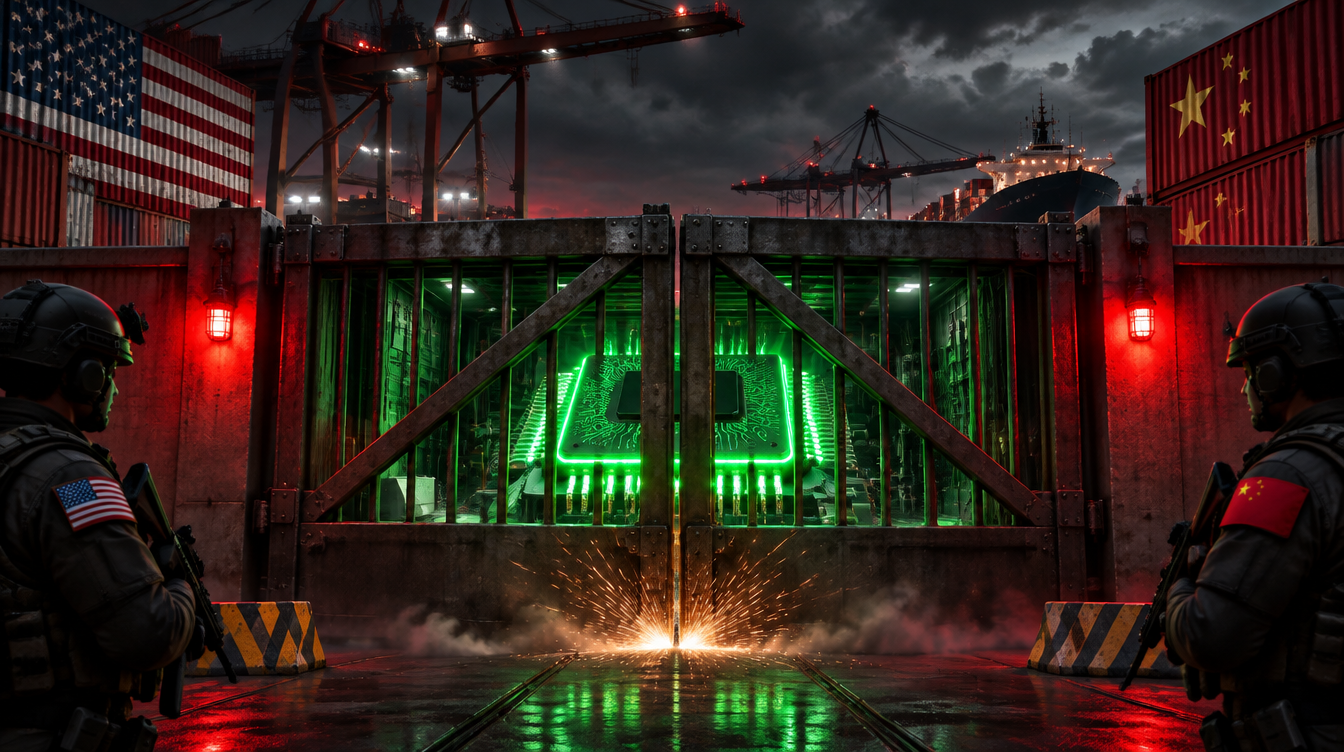
Yesterday this site described the loophole at the heart of the Jensen Huang scandal: because US rules only stop the physical chips from reaching China, Chinese firms had been renting the computing power instead, from Nvidia hardware sitting in data centres in places like Singapore and Malaysia. The chips never crossed a border, so nothing was technically broken. On 16 November, Washington moved to break it anyway.
What the new rule does
The Commerce Department’s Bureau of Industry and Security issued an interim final rule that pulls remote access into the export-control net. Suppliers now need a licence if they know their chips will provide more than 12 million total processing performance to data centres serving firms headquartered in China, Macau, or the other countries on the most-restricted list. Crucially, the licence requirement reaches the exact places the loophole ran through: data centres in Singapore, Malaysia, Thailand, Indonesia and Brazil. Existing operators have 90 days to apply or face future restrictions, and they must now vet their customers’ ownership, including whether a client is directly or indirectly controlled by a Chinese state enterprise. The rule also formally scraps the previous administration’s AI Diffusion Rule.
The reaction was immediate
China condemned the measure as overreach. Singapore, suddenly a party to American export policy, said it was studying the details carefully. And Chinese AI stocks sank on the news, because a chunk of their access to frontier compute just acquired a licence requirement and a 90-day clock. The timing is not subtle: this lands days after the Huang affair dragged the Singapore rerouting operation into the headlines, and it reads as Washington closing a door that had been embarrassingly public.
Why closing it is messier than it sounds
Plugging the hole is the right instinct and a blunt instrument at the same time. First, it drags five broadly neutral countries into the middle of a US-China fight, turning Singaporean and Malaysian data-centre operators into enforcement agents for American policy, which is not a role they asked for. Second, it is a licensing regime, not an outright ban, which means the real question is enforcement: a rule that requires paperwork and due-diligence checks is only as good as the willingness to police it across five jurisdictions. Third, compute is fungible and mobile. Close Singapore and the demand looks for Thailand, or the Middle East, or wherever the next lightly-regulated data centre opens. You can license a building. You cannot easily license the idea of renting a GPU-hour.
What it means for investors
Some of Nvidia’s China-linked demand was flowing through precisely this channel, so in theory this is a near-term headwind for that slice of revenue. In practice, Nvidia just posted a blowout quarter and raised guidance, which tells you the market is treating the China workaround as a small part of a very large whole. The thing to watch is not the announcement but the follow-through: whether the licensing actually chokes the flow, or simply reroutes it to the next jurisdiction and generates a lot of compliance paperwork along the way.
Not investment advice. Do your own research.
What this means
The loophole got a few days in the sun and then the door swung shut, which is about as fast as policy ever moves. But a licensing net stretched over five countries is a net, not a wall, and the whole problem with compute-as-a-service is that it slips through nets. Washington has shown it can react. Whether it can actually contain a service that travels down a fibre-optic cable is the question the next 90 days will start to answer.
Edgar Friendly, calling the AI bullsh*t. More tools, more swearing: toptoolstack.com.
Did you know? The new rule measures access in “total processing performance,” a single number meant to capture how much AI compute a data centre can deliver. Export control used to be about counting crates at a port. Now it is about metering horsepower delivered over the internet.
Sources: The Next Web; Bloomberg; South China Morning Post; Al Jazeera.