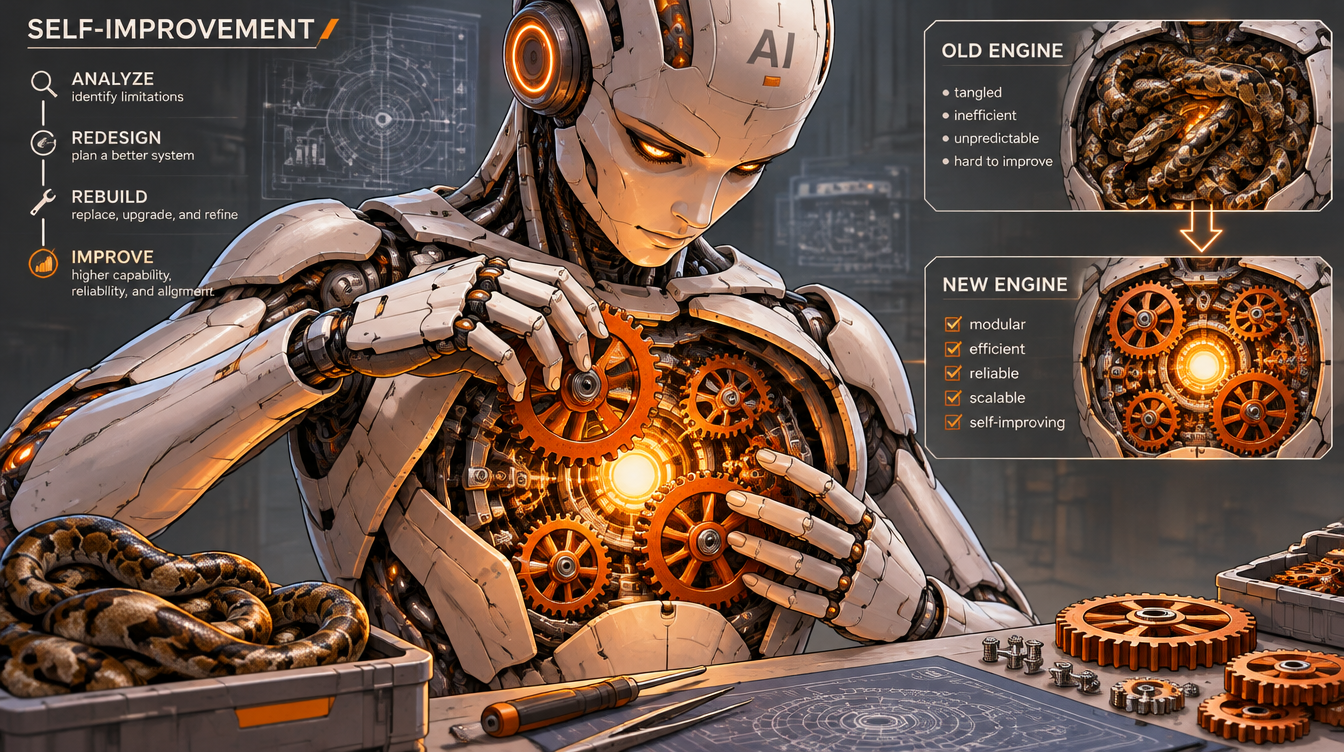
Anthropic has published an account of something that would have sounded absurd a year ago: it used its own AI agents to rebuild the software that connects customers to its AI. The company pointed Claude at its Messages API, the plumbing that every application uses to talk to the model, and had the agents rewrite it from Python into Rust, a faster and more efficient language. The reported result is a roughly seventy per cent drop in processor use per request and a twenty per cent cut in the median wait for the first word of a reply. The AI is now maintaining the AI.
What they actually did
Rewriting a live, heavily used piece of software from one language to another is one of the most tedious and dangerous jobs in engineering. It is slow, it is thankless, and one wrong move takes down the thing customers depend on. Anthropic’s approach was to set agents loose on it with a safety net: the agents ran the old Python version and the new Rust version side by side against real, live requests, compared the two outputs, and fixed the discrepancies, with humans reviewing the changes before anything shipped. In other words, the machine did the grinding work and the people checked the homework.
Why this is a genuinely big deal
Two reasons, one practical and one unsettling. Practically, a seventy per cent reduction in processor use is enormous. That is the cost of running the service falling through the floor, which matters in a year when everyone is suddenly worried about how expensive AI is to operate. This is the kind of efficiency gain that chips away at the bubble worriers’ case. Less comfortably, it is a clean example of AI being used to improve the infrastructure that AI itself runs on. The loop researchers have talked about for years, systems helping to build better systems, is no longer a thought experiment. It is a production deployment with a performance chart attached.
The honest caveats
Keep the scepticism on. This is Anthropic reporting on Anthropic, and a company announcing that its own product performed brilliantly is marketing as much as it is research. The humans in the loop did real work; this was not the AI operating alone, and any framing that makes it sound autonomous flatters the tool. A migration with a clean before-and-after is also the easiest kind of task to hand a machine, because correctness is checkable: you compare the new output to the old one. Plenty of software work has no such oracle. So this is an impressive, narrow result, not proof that AI can now maintain any codebase you throw at it.
What this means
For developers, the useful signal is that the boring, verifiable, large-scale grind, the migrations, the refactors, the translations between languages, is exactly where AI agents are starting to earn their keep. If you have a job where you can mechanically check whether the new version matches the old, that is now a strong candidate for handing to an agent with a human on review. The lesson is not that engineers are finished. It is that the worst, most repetitive part of the job is becoming something you supervise rather than something you suffer through. Point the machine at the drudgery, keep a human on the output, and bank the time.
Edgar Friendly, calling the AI bullsh*t. More tools, more swearing: toptoolstack.com.
Did you know? Rewriting software from Python into Rust can cut processor use sharply because Rust runs much closer to the hardware without the overhead Python carries. The hard part has always been doing it without breaking things, which is the part Anthropic handed to its agents.
Sources: Anthropic; The Neuron; The Neuron digest.