3 min read
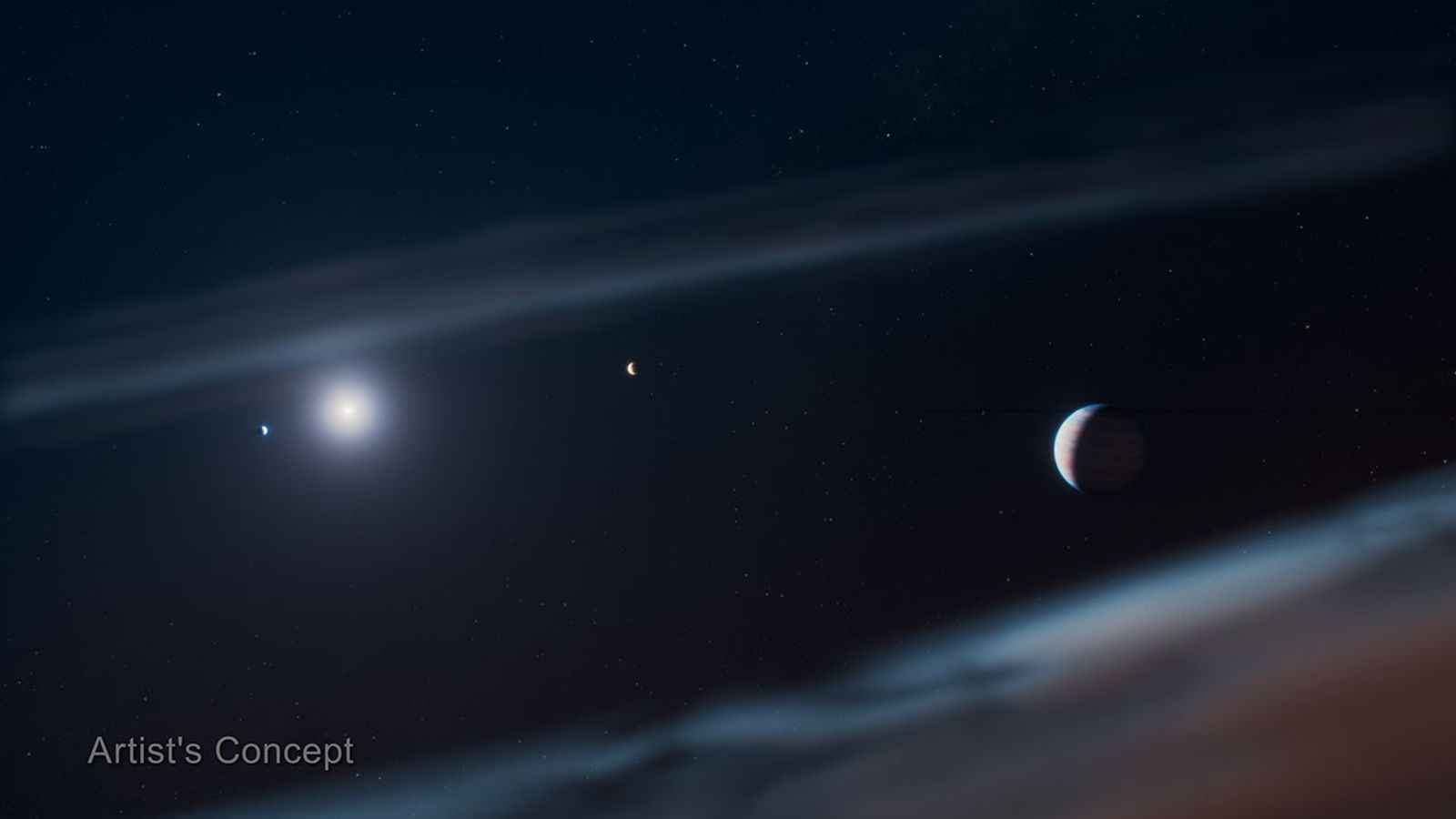
Here is a genuinely lovely bit of science to wash the taste of the week out of your mouth. Astronomers pointing NASA’s James Webb Space Telescope at the young star Beta Pictoris were not even hunting for a new planet. They found one anyway: a gas giant that had been quietly sitting in the data since 2014, spotted not by any dot of light but by the chemical signature of its atmosphere. The planet, Beta Pictoris d, gave itself away by its breath.
How do you find a planet you cannot actually see?
You read its barcode. Beta Pictoris sits 63 light-years away, wrapped in one of the brightest debris disks we know of, a haze of dust so luminous it drowns out anything trying to hide inside it. The old way of hunting planets looks for a faint pinprick of light next to the star, which in that glare is close to hopeless. So the team, led by Aidan Gibbs at UC San Diego, used Webb’s NIRSpec instrument to grab a full spectrum from every pixel, and buried in the smooth glow of scattered dust they found a distinctive comb of carbon monoxide absorption lines, spread out like a barcode. That pattern only comes from the atmosphere of a giant planet. Their full study ran in the Astrophysical Journal Letters.
Follow-up looks with Webb’s MIRI turned up water vapour and methane as well, and a completely separate team using the European Southern Observatory’s Very Large Telescope confirmed the same planet independently, working from the opposite end of the light spectrum without the two groups even talking to each other. When two rival teams stumble onto the same world from different directions, you can be fairly confident it is really there.
What it is actually like out there
Beta Pictoris d is at least twice the mass of Jupiter, the runt of the system’s three known giants, looping around its star at roughly 30 astronomical units, about where Neptune sits in our own solar system. It is young and furious, only around 23 million years old, still glowing with the leftover heat of its own violent formation. Picture Neptune’s orbit, but drop a world heavier than Jupiter into it, banded with cloud and reeking, faintly and gloriously, of carbon monoxide, water and methane.
Why this one matters beyond the headline
This is the first planet discovered primarily through this kind of moderate-resolution spectroscopy, and that is the part that will outlast the news cycle. Astronomers no longer need a planet to be a bright, well-separated dot; they can now sniff one out by its atmospheric chemistry even when it is buried in glare. Every dusty, complicated, “we already looked there” system just became worth a second pass. There is something quietly perfect about a planet hiding in plain sight for over a decade, only to be undone completely by its own exhaled gas.
The AI tool stack actually worth paying for
One email a week. The tools, models and moves that matter, minus the hype and the horseshit filter set to maximum. Free.
Did you know: Beta Pictoris was one of the very first stars shown to have a dusty disk around it, back in 1984, and its planet Beta Pictoris b was among the first exoplanets ever directly photographed. Forty years on, the same unremarkable-looking speck in the southern sky is still handing astronomers firsts. Some stars just keep giving.