3 min read
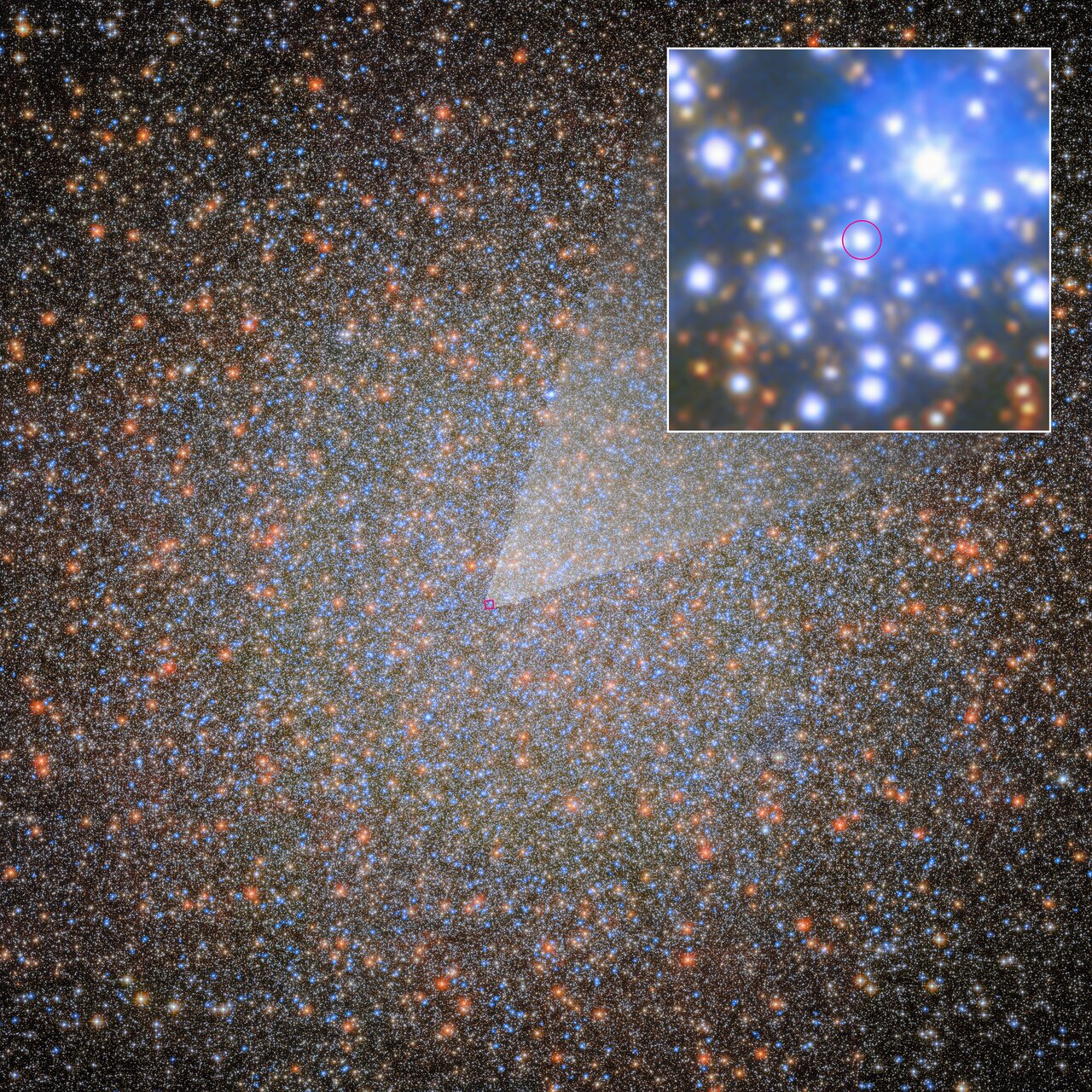
Staying in space, because the universe is on a genuine roll this week. Astronomers have finally caught the first of a vast, hidden population of black holes lurking inside Omega Centauri, a gigantic ball of ten million stars orbiting our galaxy. Models say this one cluster should be riddled with something like 10,000 small black holes, the corpses of long-dead massive stars. For decades, nobody could find a single one. Now they have their first, and they found it by watching a star dance with an invisible partner for twenty years.
A star waltzing with nothing
The black hole, catchily named oMEGACat BH-2, never shows up directly. What the team could see, using more than two decades of archival Hubble images sharpened with fresh data from the Webb telescope, was a single ordinary star being hauled around in a slow, patient circle by something heavy and completely unseen. The technique, astrometry, tracks the tiny wobble of a star across the sky, and the precision here is faintly absurd: movements measured down to a fraction of a pixel on the telescopes’ detectors, teased out across 18,000 light-years of empty space. The team’s findings ran in the Astrophysical Journal Letters.
The genuinely surprising bit
Weigh the invisible partner and it comes out at 4.46 times the mass of the Sun, too heavy to be a dead neutron star (which settles an earlier argument about what this thing actually was) yet oddly light for a black hole born in a cluster this starved of heavy elements. Its companion, a perfectly ordinary star of about 0.78 solar masses, takes a leisurely 94 years to complete a single orbit, making this the longest-period black hole binary ever found. Somewhere out there, a star is decades into a lap it will not finish in your lifetime or your grandchildren’s.
Lead author Matthew Whitaker at the University of Utah put it plainly: without both Hubble and Webb, this simply could not have been done. His colleague Anil Seth pointed at the deeper prize, noting that understanding how black holes pair up in dense clusters like this is exactly what we need to make sense of the gravitational waves that ripple out whenever two of them eventually collide.
Why finding one is a very big deal
Catching the first of ten thousand missing objects is not a footnote, it is a door creaking open. It confirms the black holes really are in there, buried in the crush of stars, and it proves that twenty-year-old Hubble data paired with a modern telescope can drag them into the light one wobble at a time. In fairness to the much-abused Hubble, now well past its planned lifespan and patched up by hand more than once, this is a hell of a party trick for a telescope launched back in 1990.
The AI tool stack actually worth paying for
One email a week. The tools, models and moves that matter, minus the hype and the horseshit filter set to maximum. Free.
Did you know: Omega Centauri is so vast and so densely packed that for centuries we filed it away as a single star. It was catalogued as “Omega Centauri” the star long before anyone worked out it was actually ten million of them, bound together into the largest globular cluster orbiting the Milky Way.