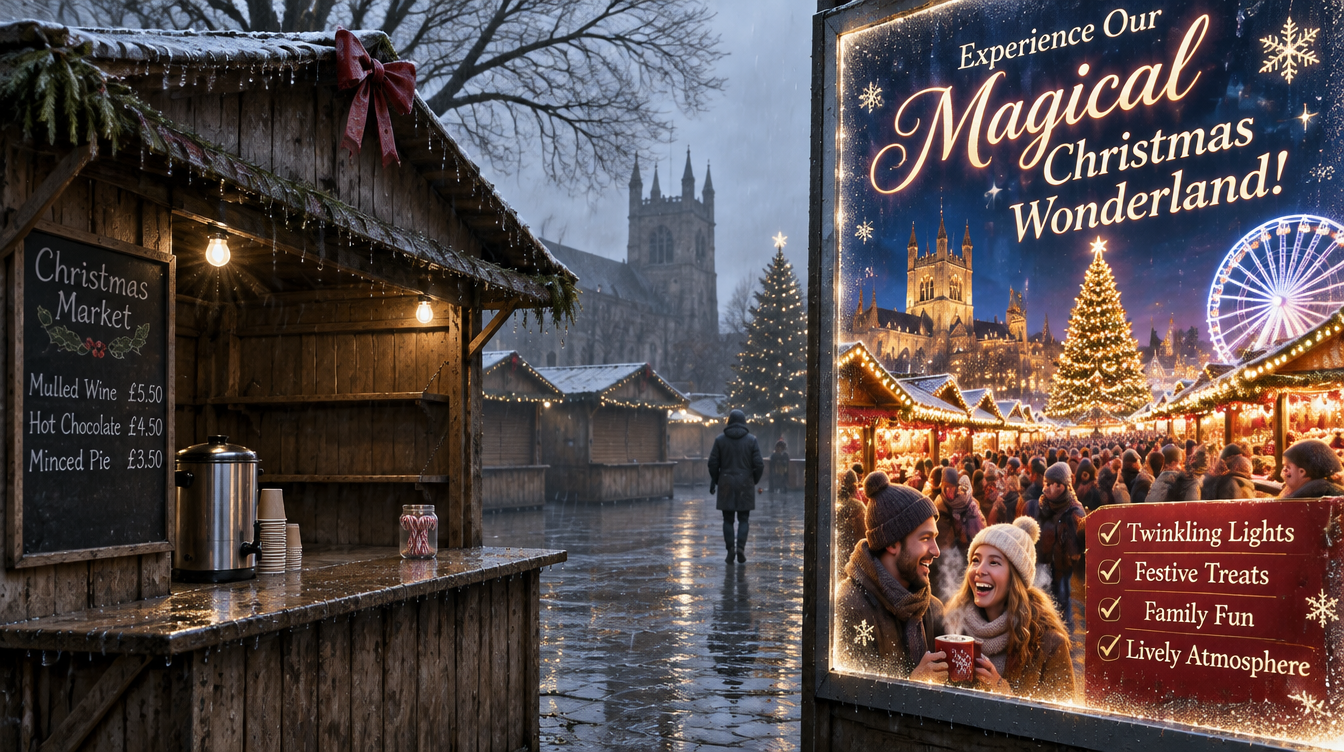
Of all the ways AI is reshaping the world this year, here is the one that will actually touch most people: the glossy photo that turns out to be a lie. A Christmas market in Cornwall cancelled all of its bookings after visitors and stallholders complained that the real event came nowhere near the magical scene promised in its promotional images, images that had been generated by AI. No fake snow, no golden lights, no bustling festive wonderland. A field, a few stalls and a lot of disappointed families who had paid to get in.
What happened
The organisers advertised the market with AI-generated pictures of a picture-perfect Christmas: twinkling lights, crowds, snow, the lot. The reality that greeted paying visitors fell so far short that the complaints forced the whole thing to be called off and bookings refunded. It is a small, almost comic story on its own. It is also a perfect, tiny illustration of a problem that is about to be everywhere, because generating a flawless fantasy image of something now costs nothing and takes seconds, while delivering the real version still takes money, effort and a decent location.
Why this is a sign of things to come
For years the rule of thumb was that a photo was broadly evidence that a thing existed and looked roughly like that. AI has dismantled that assumption. A promotional image is no longer a photograph of a real place dressed up nicely; it can be a render of a place that never existed, built to sell you a ticket. The Cornwall market is the harmless version, a ruined family day out and some refunds. The same technique sells holiday lets that look nothing like the photos, events that cannot deliver what the poster promised, and products that exist only in the generator. The gap between the image and the reality has become a business model waiting to be abused.
How to avoid getting caught
A few practical tells, because this is the useful bit. Generated promotional images tend to be too perfect, with lighting that is suspiciously flawless and crowds that on closer inspection have odd faces, melted hands or repeating patterns. Look for a real, dated photograph from an actual visitor rather than the official glamour shot. Be wary when every image of a place looks like a film poster and none of it looks like a phone snap. And apply the oldest rule there is: if the picture looks too good to be true for the price, it was probably rendered rather than photographed.
What this means
This is the everyday face of the AI hype machine, and it has nothing to do with chatbots or chip wars. It is the slow collapse of the idea that a photo proves anything. The Cornwall Christmas market is a funny story until it is your wedding venue, your holiday rental or your kid’s birthday attraction that turns out to exist only in a prompt. The defence is not technical, it is a habit: treat every too-perfect marketing image as a painting rather than a photograph, and go looking for the boring, real, slightly disappointing picture before you hand over any money. The render costs nothing to make, and the disappointment lands on whoever paid to show up.
Edgar Friendly, calling the AI bullsh*t. More tools, more swearing: toptoolstack.com.
Did you know? Generating a flawless fantasy image of an event now takes seconds and costs nothing, while actually delivering that event still takes money, staff and a real location. That widening gap between the cheap image and the costly reality is exactly where this kind of mis-selling grows.
Sources: BBC News; The Neuron.