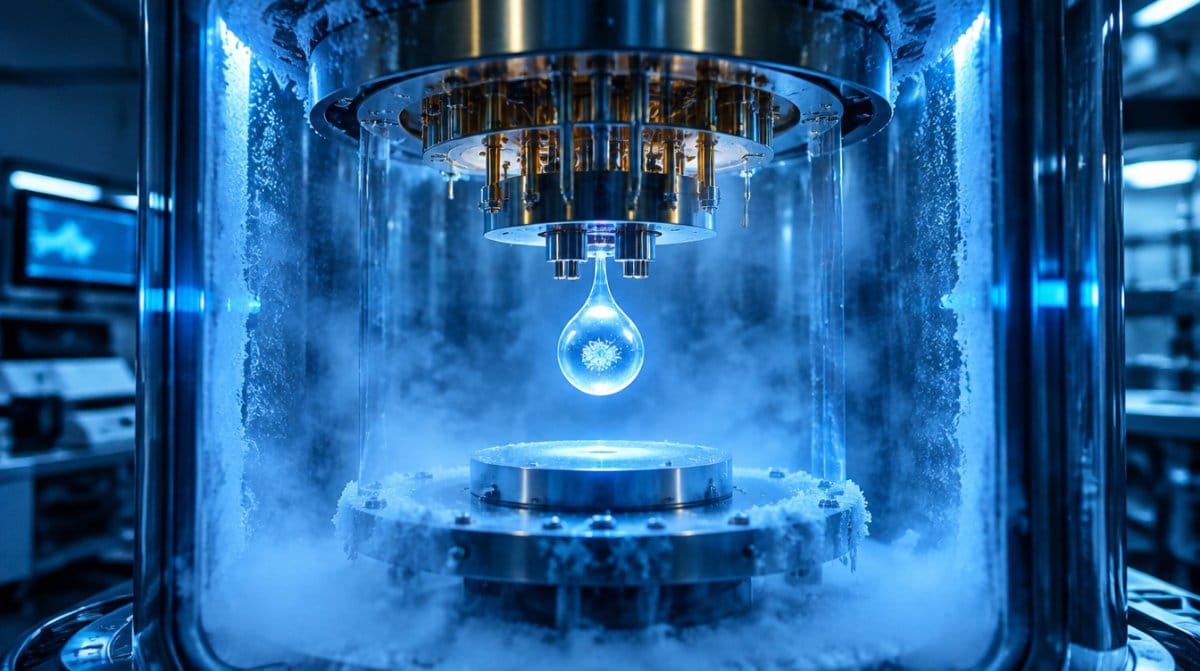
Quantum computing’s central problem is not making qubits. It is keeping them from falling apart. Qubits are absurdly sensitive to electromagnetic noise, and the more you add, the harder the errors are to control, which is why scaling has been so painful. Researchers at the University of Surrey have proposed a design that sidesteps a big chunk of that noise by building the qubit out of something exotic: superfluid helium.
The SHOQ device
The proposed design is called the Superfluid Helium Oscillator Quantum device, or SHOQ, and it uses charge-neutral superfluid helium-3. The clever bit is the charge-neutral part. Because the helium carries no electric charge, the qubit is naturally shielded from the stray electrical charges and electromagnetic disturbances that wreck conventional superconducting qubits. On the team’s modelling, that protection could cut error rates by around 100 times. The work was published in npj Quantum Information and is, by the researchers’ account, the first reported design for a superfluid-based qubit.
Why a hundredfold matters
Error rate is the whole ballgame. Today’s machines burn enormous numbers of physical qubits to produce a single reliable “logical” one, precisely because errors pile up so fast. Knock the error rate down by two orders of magnitude and the overhead for useful, fault-tolerant computing shrinks dramatically. The Surrey team suggests the technology could eventually work alongside today’s superconducting qubits or serve as a new kind of quantum memory.
The large asterisk
This is a design and a set of predictions, not a working chip. The 100x figure comes from modelling, and the gap between an elegant proposal in a journal and hardware on a bench is where most quantum breakthroughs go to die. Superfluid helium-3 is also not a trivial material to work with, requiring extreme cold and careful handling. Treat this as a promising new direction, not an imminent product.
What this means
For investors in the quantum space, the signal is that error correction, not raw qubit count, is where the real progress and the real value sit. For everyone else, it is a reminder that quantum computing is still being invented at the level of basic physics, and that the eventual winners may use materials and designs that look nothing like today’s superconducting chips.
Not investment advice. Sources: University of Surrey; npj Quantum Information; Phys.org; ScienceDaily (late Sept to early Oct 2026).