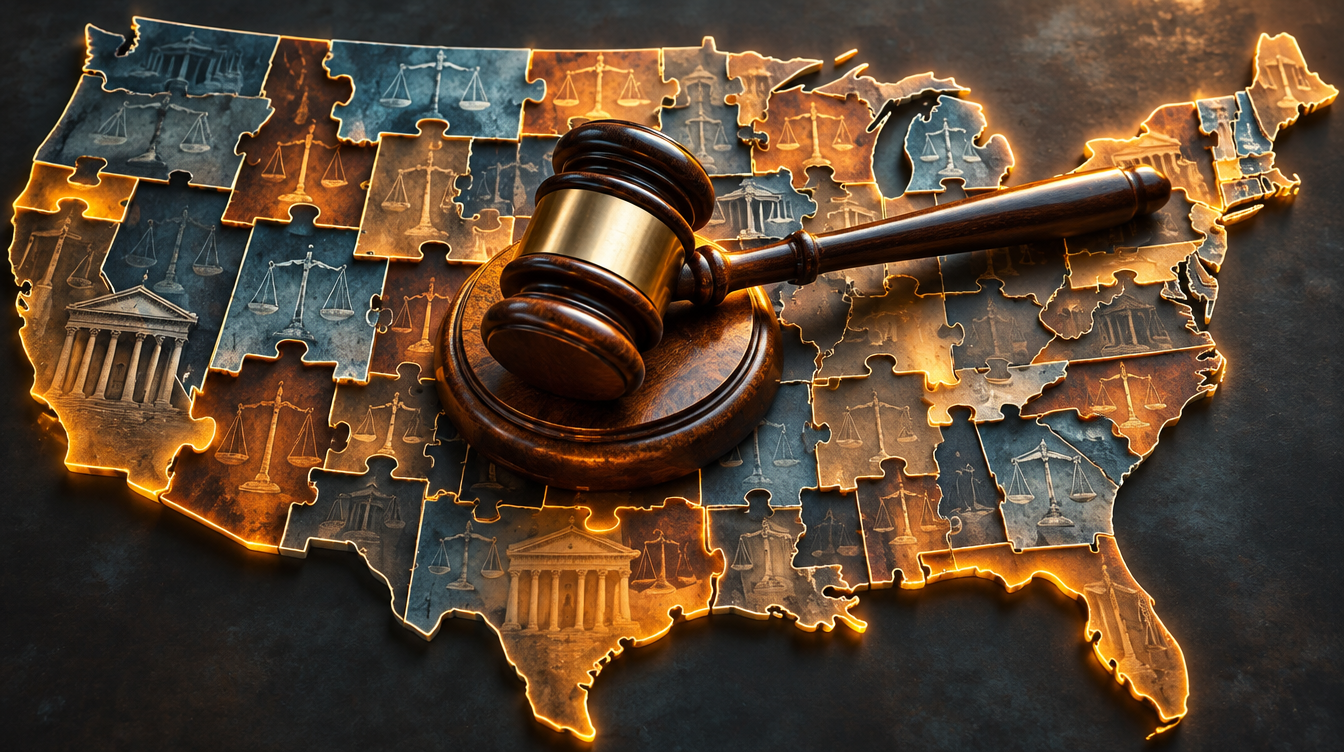
A group of US governors has asked Congress to do something unusual: write a national rulebook for frontier AI, so they do not each have to write their own. They want a federal baseline, while keeping the consumer protections their states have already passed. It sounds like dry governance. It is actually the real centre of the whole AI regulation fight, and how it resolves will decide whether the rules that govern this technology are real or hollow.
The patchwork problem
Right now, AI in America is being regulated the way everything eventually is in a federal system: one state at a time. Connecticut has passed a comprehensive AI bill. California’s governor has floated shutdown authority and mandatory safety standards. Other states are drafting their own. For a company deploying a model nationwide, that is a compliance nightmare, fifty different definitions of what is allowed, fifty sets of paperwork, fifty ways to be sued. The governors’ request acknowledges the obvious: a single federal standard would be cleaner than a patchwork. On that, almost everyone agrees.
Where it gets sharp
The agreement ends the moment you ask what kind of federal standard. There are two very different things a national rule can be, and they point in opposite directions. It can be a floor: a minimum everyone must meet, with states free to go further and keep their own stronger protections on top. Or it can be a ceiling: a single national rule that overrides, or pre-empts, the state laws, so that nothing stricter is allowed anywhere. The governors are explicitly asking for the first, a floor they can build on, while preserving their consumer protections. A good deal of the industry has been pushing for the second, a single lenient federal standard that sweeps the stricter state laws away.
That is the real battle hiding inside the boring phrase federal baseline. One version raises the minimum. The other caps the maximum. They use almost the same words and mean almost opposite things.
Why you should care which one wins
Because it determines whether AI regulation in the US has teeth. A federal floor plus active states is how you get meaningful, evolving rules, states experiment, the best ideas spread, the national minimum rises. A federal ceiling that pre-empts the states is how you get one rule, written once, in a lobbying environment the largest AI companies can heavily influence, with every stricter local protection legally blocked from existing. The same arrangement the industry frames as helpful consistency, the states experience as having their rulebooks confiscated.
What this means
The governors asking for one rulebook is not the story. The story is the word they chose, baseline, and whether Congress delivers a floor or a ceiling dressed up as one. A floor leaves room for the fifty-state laboratory to keep working and keeps the companies honest. A ceiling hands the whole regulatory question to Washington at the exact moment the industry has the most money and the most reason to shape it. Watch the preposition, not the press release: a rulebook states can build on is a very different thing from a rulebook they are forbidden to exceed.
Edgar Friendly, calling the AI bullsh*t. More tools, more swearing: toptoolstack.com.
Did you know? In US law, a federal rule that blocks states from passing stricter ones is called pre-emption. It is one of the most powerful and least-discussed tools in regulation, because it can turn a national minimum into a national maximum, depending entirely on how one clause is written.
Sources: The Neuron; AI Impact Hub.