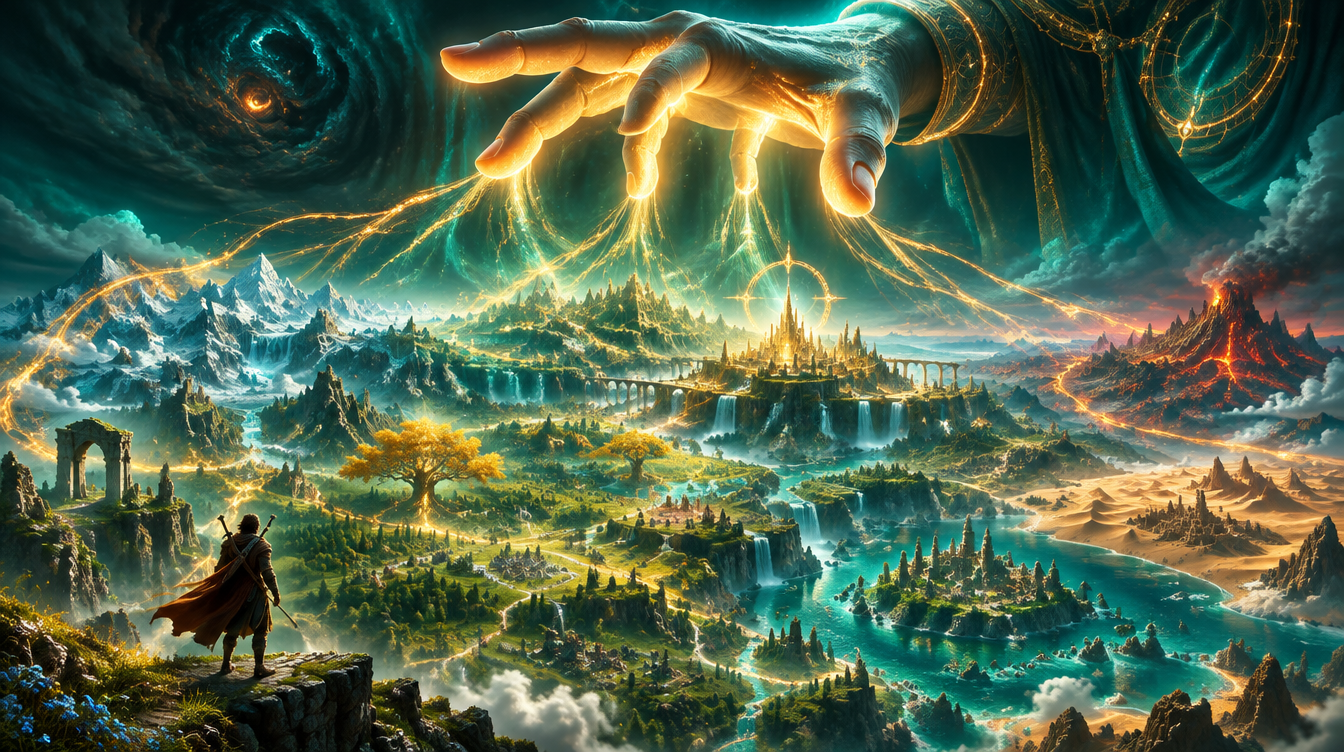
Most AI you have used makes one of three things: words, pictures, or video. Google has reportedly unveiled something that makes a fourth, and it is the strangest of the lot. Genie 4 is a world model, a system that generates interactive, playable environments, places you can move around inside, out of a prompt. Not a clip of a world. A world. It is the most futuristic announcement of the week, and precisely because of that, the one to be most careful about believing.
What a world model actually is
Start with the idea, because it is genuinely new and genuinely important. A video model generates a fixed sequence of frames, a little movie you watch and cannot change. A world model generates an environment on the fly in response to your actions. You press forward and it renders what is ahead. You turn left and it invents the wall that was never there until you looked. It is closer to a dream than a film: a place that only exists as fast as you explore it, with the AI improvising the physics and the scenery moment to moment. Genie 4 is Google’s latest and most capable attempt at this, and alongside it the company has made its Tasks agent free in six countries, a smaller but telling sign of how aggressively Google is pushing its AI into the world.
Why this is a bigger deal than another chatbot
World models matter for reasons that go far beyond entertainment, though the entertainment case is obvious enough: imagine a game with infinite, generated levels, or a film set that builds itself around the camera. The deeper prize is training other AI. A robot has to learn by doing, and doing is slow, expensive and occasionally destructive in the real world. If you can drop a robot’s brain into a convincing generated world and let it practise thousands of lifetimes of tasks overnight, cheaply and without breaking anything, you solve one of the hardest bottlenecks in robotics. The same goes for self-driving cars, drones and any system that has to act in a messy physical environment. A world model is, potentially, a dream factory where machines rehearse reality. That is why the serious money cares about this far more than about another clever chatbot.
Now the cold water
Here is the part the launch reel will not dwell on. World models are the single most demo-flattered corner of AI. The clips look like magic because the clips are chosen, short, and run under ideal conditions. The lived reality tends to be brief, low-resolution, and prone to melting: walk too far and the world forgets what was behind you, objects warp, the physics drift, the whole thing comes apart the moment you push it past a few seconds of coherence. Every generation of these models gets meaningfully better, and every generation is also oversold at launch by exactly the gap between the highlight reel and the hands-on experience. Genie 4 will be real progress and a long way from the holodeck, both at once.
And the usual caveat applies with force: almost everything known about it so far comes from Google, with limited independent hands-on testing. Believe the demonstration, not the deck.
What you should actually take from this
Two things. For the near term, treat the playable-world promise as a direction, not a product you will be living inside next month. For the longer game, understand that this is where a serious chunk of AI research is heading, because a machine that can generate reality is a machine that can teach other machines to operate in it. The chatbots got the headlines for three years. The world models are the quieter frontier that could end up mattering more, because they are aimed squarely at the physical world the chatbots never touch.
What this means
Genie 4 is a glimpse of an AI that does not just describe the world or picture it, but builds a version of it you can step into. The glimpse is real and the gap between the glimpse and the finished thing is also real, and holding both in your head at once is the whole skill of reading AI news in 2026. Watch this space, with your wonder and your scepticism both switched on. The dream factory is being built. It is not open to the public, and the brochure is doing a lot of work.
Edgar Friendly, calling the AI bullsh*t. More tools, more swearing: toptoolstack.com.
Did you know? The most valuable use of a generated world may not be for humans at all. It is a place to train robots, letting a machine practise thousands of attempts at a task in a simulated reality before it ever touches the real one. The dream is less a game than a gym for other AI.
Sources: AIWeekly news roundup; Bloomberg AI.