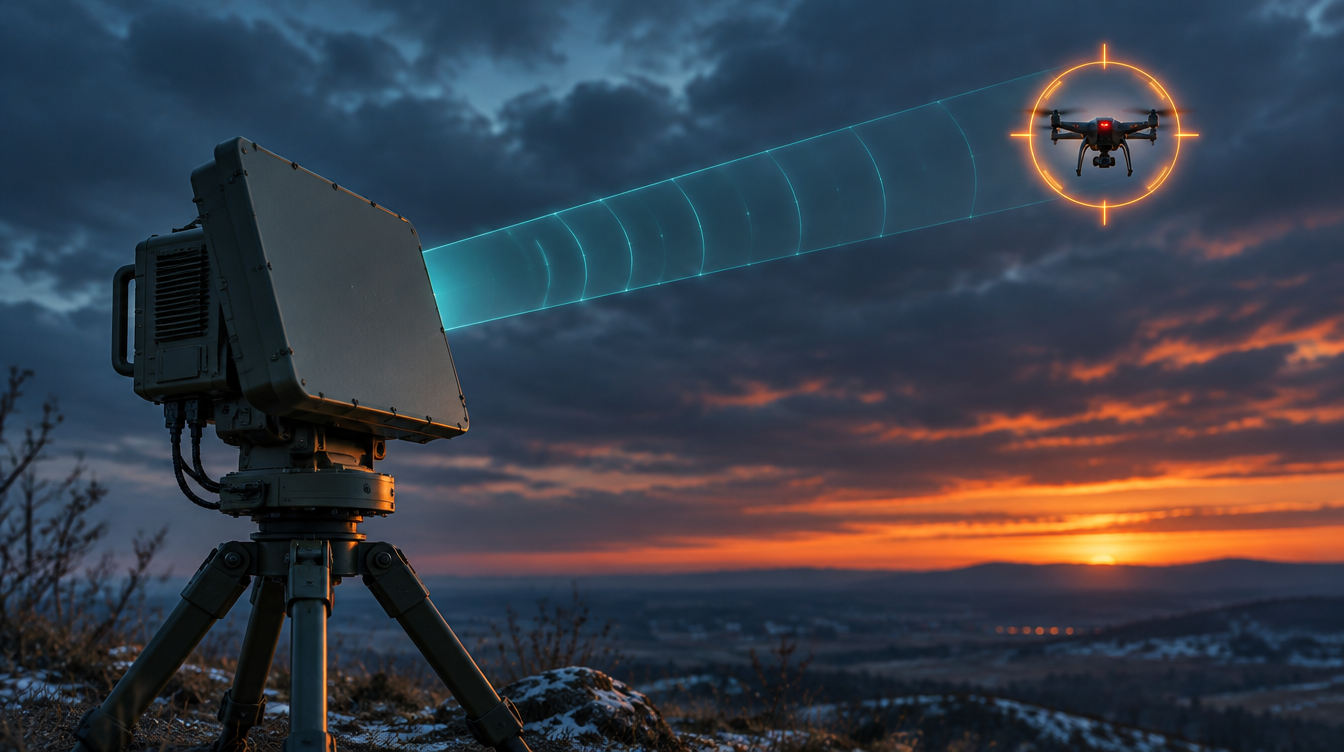
For two years the defining story of modern war has been the cheap attack drone: a few hundred dollars of plastic and explosive that can kill a tank or sink a warship. The sequel is now being written, and it is worth a great deal more money. On 5 November, Shield AI agreed to buy the radar maker Echodyne for up to 5.3 billion dollars. The whole deal is about one thing: stopping the drones.
The deal
Shield AI, best known for autonomous combat aircraft, is paying 4.8 billion dollars at closing, with up to 500 million more tied to performance targets. Echodyne, a Kirkland, Washington company once backed by Bill Gates, makes the compact radars used in counter-drone and security systems in more than 40 countries, with the US military among its customers and a recent 250 million dollar contract with the Defense Department’s counter-drone task force. To fund it all, Shield is raising 2.5 billion dollars, including 1 billion in new money at a 28.8 billion dollar valuation, a round that only proceeds if the acquisition closes, which is expected in early 2027.
This is a category, not a one-off
Shield buying Echodyne is the loudest move, but it is one of many. India has unveiled an AI-enabled turret built to detect, track and engage drones, swarms included. The US Army has been testing an AI acoustic sensor network in South Korea to hear incoming first-person-view drones. Russia’s Kalashnikov has introduced an AI decision-support system that ties drone-detection gear and defensive weapons into a single network. The US Air Force is shopping for rapidly deployable swarms of AI-controlled drones just to guard its own bases. Everywhere you look, the same bet: the attack drone made every base, port, pipeline and power station suddenly vulnerable, and defending against them is the next enormous market.
Why the money is moving now
Because the threat got proven and the defences did not keep up. A war can be reshaped by drones that cost less than a laptop, and no military on Earth has a cheap, reliable way to swat them in bulk. That gap is the business opportunity. The clever part of the Shield move is what it combines: Shield brings autonomous decision-making and effectors, Echodyne brings the sensing. Detecting a small, fast, low-flying drone is the hard half of the problem, and AI on the trigger is useless without AI on the eyes. The deal is a bet that counter-drone becomes a sense-and-respond system, sold not only to armies but, as Shield has signalled, to public-safety buyers guarding stadiums, airports and borders.
Bull, bear, neutral
Bull: structural, durable demand, government buyers with real budgets, and a genuine capability gap that nobody has closed. Shield’s 28.8 billion dollar valuation sits on actual contracts, not vapour.
Bear: the valuations in this space are running hot and fast, the deal is contingent on a close that is still months away, and counter-drone is a permanent cat-and-mouse, which is wonderful for recurring revenue and terrible for anyone claiming a finished solution.
Neutral: watch whether the acquisition actually closes in early 2027, how Echodyne’s contract backlog grows, and whether counter-drone starts showing up as a distinct line in national defence budgets. That line item is the real tell.
Not investment advice. Do your own research.
What this means
The cheap attack drone created a problem the whole world now shares, and the response is a counter-drone arms race with AI on both sides of the exchange: one model deciding to strike, another deciding to stop it. The 5.3 billion dollar Shield deal is the clearest sign yet that the smart money has stopped watching the attack and started funding the defence. The war taught everyone the lesson. Now everyone is buying the answer.
Edgar Friendly, calling the AI bullsh*t. More tools, more swearing: toptoolstack.com.
Did you know? Echodyne’s radars are small enough to mount on a vehicle or a fixed post, and they are already deployed in more than 40 countries. The hard part of stopping a drone is not hitting it. It is seeing it coming.
Sources: Breaking Defense; Defense News; GeekWire; DroneXL.