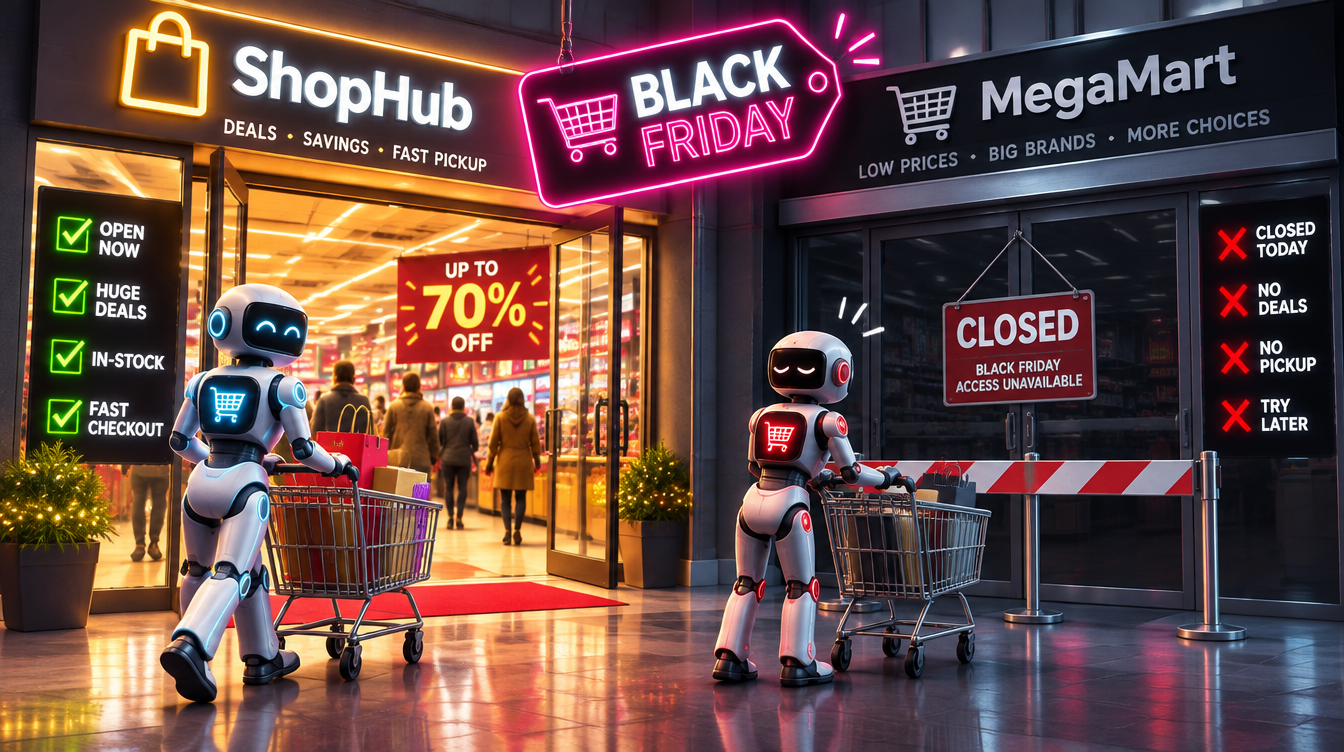
This Black Friday, the most important shopper in the room might not be a person at all. Walmart has thrown its doors open to AI shopping agents, software that hunts for products and checks out on your behalf, while Amazon spent the autumn blocking the same agents from its store. Now, with the numbers in, Amazon is reportedly in talks to let at least one of them back in. The fight is not really about convenience. It is about who controls the moment you hand over your money.
What each side is doing
Walmart built something it calls Agent Gateway, which lets an outside AI agent, ChatGPT, Gemini or Meta’s Muse among them, browse its inventory and buy for a customer. It wrapped that in sensible guardrails: each agent gets its own account section so its purchases stay separate from yours, you can set spending limits, and the agent never touches your card details. Amazon went the other way. It blocked Perplexity’s shopping agent and Meta’s Muse, and pushed its own tools instead, such as Alexa and its Buy for Me feature. Two of the biggest retailers on Earth looked at the same technology and made opposite bets.
Why Amazon is reportedly backing down
Because the numbers got hard to ignore. According to The Decoder, Meta’s Muse already accounts for more than half of all AI-agent shopping orders, and Amazon and Meta are now discussing lifting the block. The sticking points are revenue and control: Amazon runs an advertising business worth around sixty-eight billion dollars a year, built on controlling what you see when you search. An AI agent that shops for you skips the search page, the sponsored listings and the carefully ranked results, and goes straight to the product. That is wonderful for you and a direct threat to the most profitable part of Amazon’s operation.
The catch nobody is advertising
Here is the part worth slowing down on. When an agent does your shopping, it decides what you see. Walmart says its gateway shows agents the same prices a human would see, which is a reassuring promise precisely because it would be so easy to break. The whole value of owning the agent is that you own the choice. Today it fetches the thing you asked for. Tomorrow it can lean toward the product whose maker paid for the privilege, and you would never know, because there is no search page left for you to scroll and compare. The agent is the shelf now, and somebody arranges the shelf.
What this means
Agentic shopping is arriving fast, and this Black Friday is the first one where it genuinely matters. Used well, it is a real gift: set a budget, describe what you need, let the machine do the tedious comparison. The thing to watch is whose interests the agent actually serves. A tool you pay for, that works for you, is worth having. A free one that someone else monetises is a salesman in a trench coat, and the better it gets at shopping, the harder it becomes to tell which kind you are using. Pick the agent whose incentives match yours, set the spending limit, and read what it bought before you celebrate the time you saved.
Edgar Friendly, calling the AI bullsh*t. More tools, more swearing: toptoolstack.com.
Did you know? When an AI agent buys for you, it replaces the search page where sponsored listings live. That page is where Amazon earns much of its roughly sixty-eight billion dollars in annual advertising revenue, which is why letting someone else’s agent shop is a far bigger deal than it looks.
Sources: The Decoder; TechCrunch; Finimize.