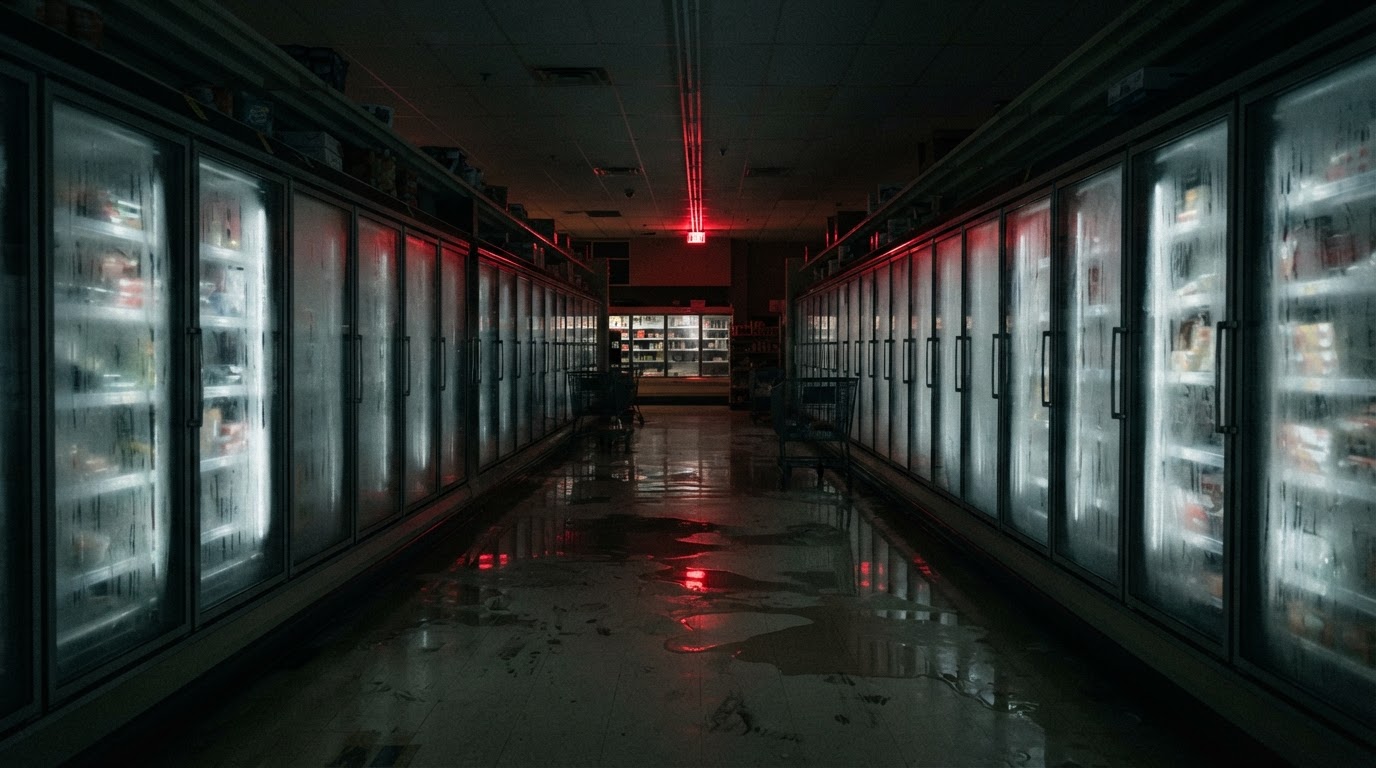
Somewhere in Europe this month, someone turned a supermarket freezer up to roughly fifty degrees and walked away. No clever artificial intelligence, no zero-day masterpiece, no ransom note worth the name. A soft target, a known weakness, and a shrug. That last part is what should frighten you.
What happened to the freezers
On 2 November a wave of cyberattacks hit refrigeration systems at supermarkets across Sweden, the Netherlands, Belgium, Ireland, Luxembourg and Estonia. It followed earlier incidents in France, where reports put the number of affected stores at between 500 and 700, with some freezer units driven up towards fifty degrees Celsius. Frozen stock spoils, fridges full of meat and dairy go in the bin, and the shop eats the loss.
These were not sophisticated attacks. The refrigeration and building-management systems that run a modern supermarket are often old, connected straight to the internet, badly patched and protected by passwords a bored teenager could guess. The attackers did not need to be clever. They needed the shops to be careless, and the shops obliged.
Here is the uncomfortable bit
The United Kingdom’s National Cyber Security Centre has been clear that attacks like these do not require AI. The flaws are ancient and the tooling is cheap. But the same body warns that AI is about to make exactly this kind of attack far easier, faster and more widespread, and it expects AI-enabled attacks on critical national infrastructure to be a realistic prospect by 2028.
So the freezers are a rehearsal. Today a human has to find each vulnerable system, log in and fiddle with the settings. Tomorrow an AI agent does the finding, the logging in and the fiddling across ten thousand sites at once, overnight, for the price of an API bill. The supermarket freezer is not the prize. It is the proof of concept.
Why a melted freezer is a national security story
Scale it up. The same weak, internet-connected control systems run cold chains for vaccines and medicines, water treatment, hospital heating, logistics depots and food distribution. A nuisance attack on a frozen-pizza aisle uses the identical playbook as an attack on a hospital’s cold storage. The difference is intent, not capability.
And this is where it stops looking like ordinary crime and starts looking like hybrid warfare on a trial run. Cheap, deniable, disruptive, aimed at the soft civilian underbelly of a rival economy. Nobody has to declare anything. You make life in the enemy’s supermarkets a bit worse, a bit more expensive, a bit less trusted, and you do it from a laptop in another jurisdiction while your government denies all knowledge.
What a sensible business should actually do
If you run anything with internet-connected building or refrigeration controls, the fixes are boring, and that is the point: get those systems off the open internet or behind a proper gateway, change the default passwords, turn on multi-factor authentication, separate the control network from everything else, and log who touches the settings. None of this is glamorous and none of it needs AI to defend against, yet. The window in which simple hygiene is enough is closing fast.
What this means
Europe’s freezer hacks are being written up as a weird news story about warm ice cream. They are nothing of the sort. They are a public demonstration that the machinery underpinning daily life is wide open, and the only reason the damage has been small is that the attackers have not bothered to try hard. AI removes the bother. The freezers are the warning shot, and we are treating it like a punchline.
Edgar Friendly, calling the AI bullsh*t. More tools, more swearing: toptoolstack.com.
Did you know? A lot of industrial control kit still speaks protocols designed in the 1970s and 1980s, built for a world where nothing was online and nobody was hostile. We connected it all to the internet anyway.