A claim has been doing the rounds: Nvidia says new software can crunch a quantum computing task that used to take 12 weeks in about 45 minutes, and it runs on ordinary GPUs rather than some exotic new quantum chip. It sounds like either a miracle or a marketing stunt. It is neither. The underlying technology is real and genuinely important, and the way the headline is being understood is almost entirely wrong. Both of those things are worth your time, because the gap between them tells you how the quantum computing race is actually going to be won, and by whom.
Let me take the hype apart carefully, because this one rewards it.
What Nvidia actually announced
On 16 November, Nvidia said it plans to build a modular quantum-classical computing platform with IBM and the US government’s Fermi National Accelerator Laboratory, co-locating IBM quantum machines with Nvidia’s own systems. Alongside that, it released a GPU-accelerated error-correction decoder, part of a software library called CUDA-Q QEC, and claimed it delivered up to a 13,000-times speedup over a baseline in one specific benchmark. The 12-weeks-to-45-minutes figure comes from this work. According to Nvidia, the new algorithm cut a particular research computation, the job of evaluating candidate error-correction codes and decoder configurations, from roughly 12 weeks down to about 45 minutes.
Read that last sentence again, because it is the whole story. The task that got faster was research. It was not a quantum computer solving a problem. That distinction is the difference between the real achievement and the viral misunderstanding.
The jargon, in plain English
To see why, you need to understand what a decoder does, and it is worth the two minutes. Quantum computers are built on qubits, which are gloriously powerful and absurdly fragile. They lose their state at the faintest disturbance, so a useful quantum computer cannot rely on a single physical qubit for anything. Instead it spreads one reliable logical qubit across many physical ones, and constantly checks for errors using a scheme called quantum error correction.
Those checks do not tell you the answer directly. They produce a stream of hints, called syndromes, that indicate something went wrong somewhere. A decoder is the piece of software that reads that stream of hints and works out which errors actually occurred, so the system can correct them. Here is the catch that makes it hard: on a real quantum computer, the decoder has to keep up in real time, because new errors are piling up every microsecond while it thinks. A decoder that is too slow is worse than useless, because the quantum state rots faster than you can fix it. Decoding, in other words, is one of the genuine bottlenecks standing between today’s noisy prototypes and a fault-tolerant machine. It is a deeply unsexy problem and it matters enormously.
So is it bullsh*t? No. But.
The technology is real. GPUs are very good at the massively parallel number-crunching that modern decoders require, and using them to accelerate this work is a legitimate and valuable idea. Nvidia is not inventing a story. But there are three large caveats the viral version drops.
First, the headline number describes an offline research task, not a quantum computer running faster. Speeding up the evaluation of decoder designs from 12 weeks to 45 minutes helps researchers test more ideas, more quickly. That is useful. It does not make any quantum computation 12 weeks faster, and it does not bring fault tolerance 12 weeks closer. Anyone repeating it as proof that quantum computers just got dramatically faster has misread it.
Second, the figure comes from Nvidia, in a specific benchmark of Nvidia’s choosing, with no independent verification published yet. A 13,000-times speedup over a baseline is only as meaningful as the baseline, and vendor benchmarks are chosen to flatter. Treat it as a company claim, not a confirmed result.
Third, the related real-time demos this announcement rode in on are more hedged than they sound. In a separate, widely-shared result, Nvidia and the hardware firm Quantum Machines reported a round-trip decoding latency of about 2.4 microseconds. Impressive, but that test ran on pre-sampled, simulated error data, and the decoder in that particular demo was a classical matching algorithm, not the GPU belief-propagation decoder at the centre of the 13,000-times claim. The pieces are real. They have not all been shown working together, at speed, on a live quantum processor at scale.
The genuine debate experts are having
This is where it gets interesting, and where honest people disagree. Whether GPUs are the right tool depends entirely on where the decoder sits.
For offline work, designing codes, testing decoders, simulating error correction, GPUs are excellent, and research shows they scale better than CPUs as the codes grow more complex, with a reassuringly short latency tail. This is exactly the use case Nvidia’s headline number describes, and it is the least controversial claim in the whole field. On that ground, Nvidia is on solid rock.
For the harder job, decoding inside the live feedback loop of a running quantum computer, the picture is murkier. Skeptics, including researchers who favour specialised FPGA chips, point out that shipping data to a separate GPU adds real latency: kernel launch delays, PCIe or network hops, and the awkward fact that GPUs love to work in batches while real-time error correction demands an answer in microseconds, every round, with no waiting. One architecture study found that camera readout and GPU decoding were the single biggest contributors to delay. Another found that fancy neural-network decoders slow down so much at larger code sizes that errors accumulate faster than they can be cleared. The strongest latency numbers in the field, on all sides, still come mostly from vendor-linked work or unreviewed preprints. An expert skeptic wants to see end-to-end measurements on real hardware at scale, and those are thin on the ground.
The honest summary: Nvidia is making its loudest claim in the arena where GPUs are strongest and least contested, while the genuinely hard, in-the-loop problem at scale remains unsettled.
The real story: Nvidia wants to own the classical half of quantum
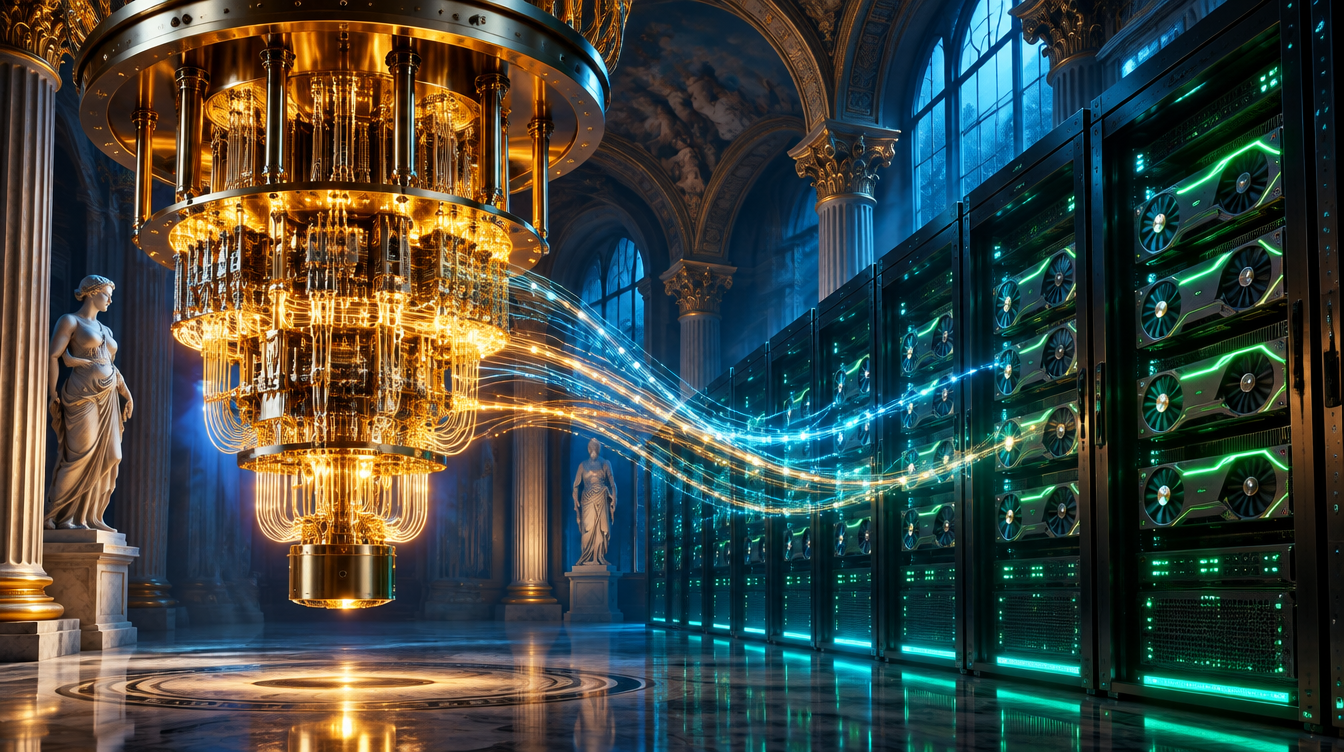
Step back and the strategy snaps into focus, and it is the same one that made Nvidia the most important company in AI. A quantum computer is not just qubits. It is qubits plus an enormous amount of classical computing wrapped around them, controlling, calibrating, and above all decoding. Nvidia has quietly set out to own that classical half, so that whoever wins the quantum hardware race, the brain doing the error correction next to it is an Nvidia GPU.
Look at the footprint. Nvidia has a software stack for it, CUDA-Q. It has a dedicated interconnect for linking quantum processors to its GPUs, called NVQLink. It has taken a strategic equity stake in the error-correction startup Riverlane. And it is partnering across the entire ecosystem, with IBM and Fermilab on the new platform, with Quantum Machines on control hardware, with Alice & Bob and IQM on their respective qubit designs. It is doing to quantum computing exactly what it did to AI: not betting on one winner, but selling the indispensable shovels to everyone digging, and making sure the picks are all Nvidia-branded. The 13,000-times headline is a billboard for that strategy.
What this means for you
If you took one thing from the viral post, replace it with this. Nvidia has not made quantum computers 12 weeks faster, and fault-tolerant quantum computing is still years away. What Nvidia has done is make an important piece of the surrounding classical infrastructure meaningfully faster, publish an eye-catching and so-far-unverified benchmark to prove it, and tighten its grip on the part of quantum computing that it is best placed to dominate no matter who builds the best qubit. That is less miraculous than the headline and considerably more consequential, because it is a bet on owning the toll road rather than any single car on it.
For anyone watching this as an investment theme rather than a science story, that is the tell worth holding on to: the durable value here is not one benchmark. It is the quiet positioning to be essential to everyone else’s quantum computer.
Not investment advice. The performance figures described are company claims that have not been independently verified. Do your own research.
What this means
The claim is real, the framing is wrong, and the strategy underneath both is the thing to watch. GPUs did not just leapfrog quantum hardware. Nvidia positioned itself so that when quantum hardware finally arrives, it cannot run without an Nvidia chip sitting next to it doing the unglamorous, essential work. That is not a 45-minute miracle. It is a decade-long land grab, and it is going rather well.
Edgar Friendly, calling the AI bullsh*t. More tools, more swearing: toptoolstack.com.
Did you know? A fault-tolerant quantum computer may need thousands of fragile physical qubits to produce a single reliable logical one, with error-correcting decoders running continuously in the background just to stop the whole thing falling apart. The quantum magic depends on a mountain of very ordinary classical computing, which is precisely the mountain Nvidia is trying to own.
Sources: Quantum Computing Report; The Quantum Insider; Quantum Machines; Nvidia CUDA-Q QEC documentation; arXiv: Real-Time QEC System Stack.