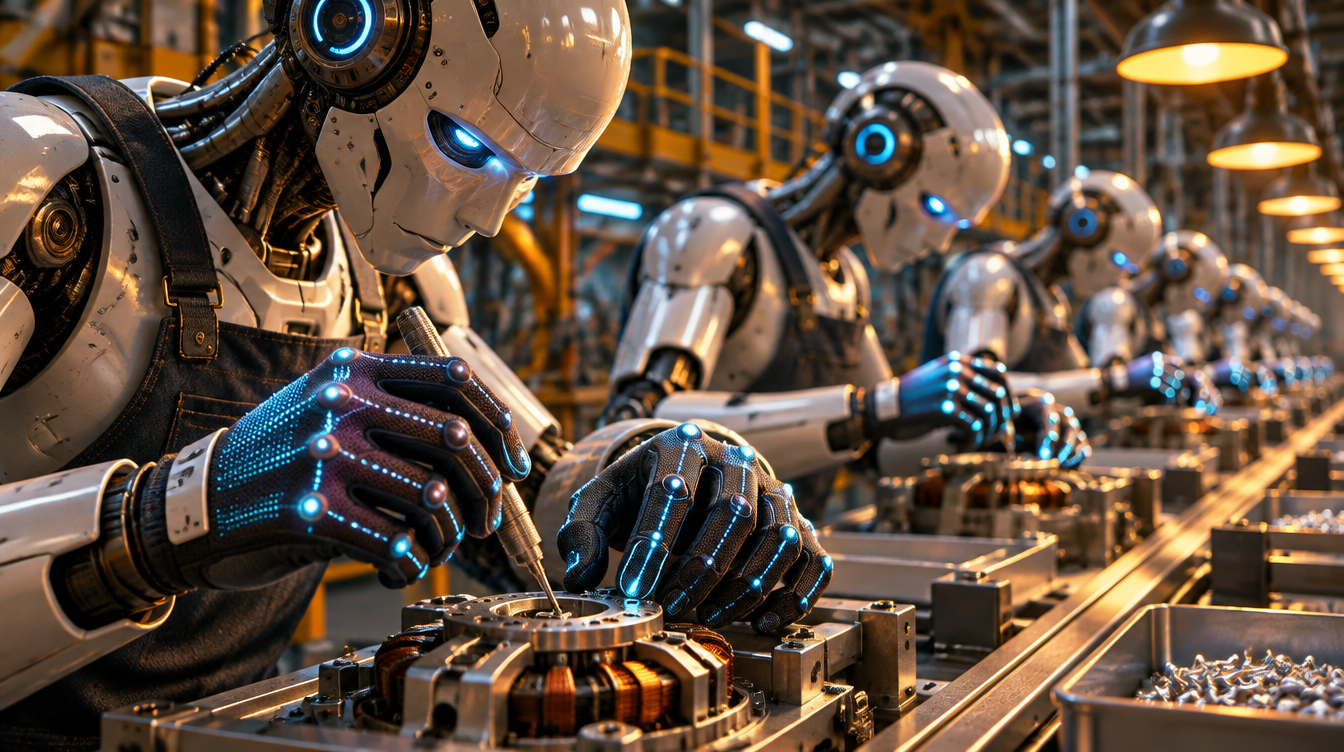
Everyone is chasing the humanoid robot, but the money has worked out where the real problem is, and it is not walking or talking. It is hands. On 17 November, a startup called Genesis AI raised 500 million dollars in a Series A at a 3.5 billion dollar valuation, aimed squarely at the single hardest unsolved problem in robotics: giving a machine human-level dexterity. The most telling detail in the whole announcement is that its robot hands currently wear out after a few weeks.
The raise
The round was led by Khosla Ventures, Premji Invest and Eclipse, and follows a 105 million dollar seed only last year. The cash goes into Genesis’s flagship robot, named Eno, which the company is aiming at factories, warehouses, laboratories and other industrial settings. So far it has built somewhere between 30 and 40 of them and is piloting with a small number of undisclosed customers, with mass production targeted for 2027. For context, humanoid-robot funding topped a billion dollars in a single week, so Genesis is riding a wave, not making one.
Why hands are the whole game
A robot that can walk across a factory is impressive and, increasingly, solved. A robot that can pick up an unfamiliar object, feel how much force to use, and manipulate it the way a human worker does, all day, without crushing it or dropping it, is not. Dexterity is the bottleneck that stands between today’s demos and the actual prize, which is replacing or augmenting human hands across manufacturing and logistics. Whoever genuinely cracks it unlocks a market measured in trillions. That is why a company with a few dozen robots can command three and a half billion dollars.
Genesis’s bet on how to crack it is the interesting part. Rather than programming dexterity, it is recording it. The company collects force data from more than 100 workers around the world wearing sensor-equipped gloves and headset cameras, capturing not just where human hands move but how hard they press. The robot learns from people doing real work. It is a smart approach, and a reminder that the current path to human-level machines runs straight through enormous amounts of human labour feeding the training set.
The tell that it is early
Now the detail that should keep your feet on the ground. Genesis’s dexterous hands can only operate for a few weeks of regular work before they need to be replaced. Sit with the economics of that for a second. The entire value proposition is a tireless worker that costs less than a human, and the critical component currently fails roughly monthly. A 3.5 billion dollar valuation on a company whose core part wears out that fast is the purest possible expression of how badly investors want this to be true, well ahead of the evidence that it is.
Bull, bear, neutral
Bull: dexterity is the key that unlocks the whole automation market, the data-glove approach is clever, the backers are serious, and being early to a trillion-dollar problem is where fortunes are made.
Bear: 30-odd robots, hands that fail in weeks, mass production that is a year away and described as a target rather than a plan, and a 3.5 billion dollar price on a Series A. This is frontier froth with a durability problem at its heart.
Neutral: ignore the valuation and watch one number, how long the hands last. Hand durability is the make-or-break metric. If it goes from weeks to years, the thesis is real. If it does not, none of the rest matters.
Not investment advice. Do your own research.
What this means
The robot money has moved off the glamorous full-body humanoid and onto the unglamorous, decisive problem of the hand, which is exactly where a serious observer would want it to go. Genesis is betting half a billion dollars that the way to teach a machine human dexterity is to record humans doing the work, and it may well be right. Just keep your eye on the part that currently breaks every few weeks, because in this business the hand is the whole argument.
Edgar Friendly, calling the AI bullsh*t. More tools, more swearing: toptoolstack.com.
Did you know? Genesis trains its robots on force data from more than 100 workers wearing sensor gloves. The machine meant to replace human hands is learning, quite literally, from human hands, one gripped object at a time.
Sources: TechCrunch; PYMNTS; The Defiant.