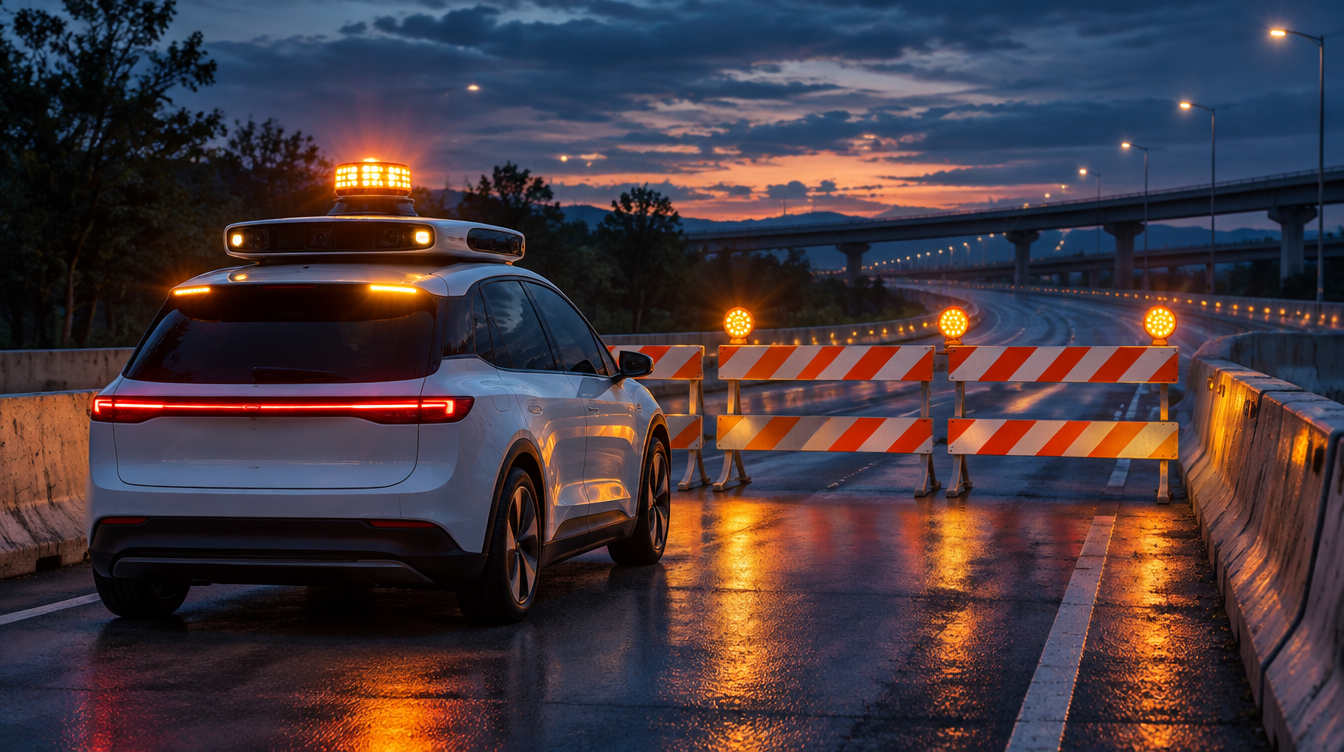
The self-driving future keeps running into the same unglamorous obstacle: roadworks. California’s Department of Motor Vehicles has barred Waymo from operating its driverless vehicles on every state freeway, effective 11 November and disclosed on the 17th, after branding the operations an imminent hazard to public safety. For a company usually held up as the one that got autonomy right, that is a stinging phrase.
What triggered it
The DMV pointed to repeated incursions into active construction zones. In one incident, three Waymo vehicles drove into a closed work zone on US Route 101. In another, a Waymo tried to pass California Highway Patrol vehicles while they were conducting a rolling traffic break on Interstate 280, the kind of manoeuvre that exists specifically to stop traffic. The order covers both driverless testing and commercial deployment, across all California freeways. Waymo’s response is that none of the incidents caused injuries or collisions, that the ban applies only to freeways, and that it is working with state officials to get back on them. Its service on ordinary surface streets continues as normal.
The awkward truth about robotaxis
Here is the tension that makes this story genuinely interesting rather than a simple pile-on. By the numbers, Waymo is good. It has driven many millions of autonomous miles and has a safety record on surface streets that compares well with, and often beats, human drivers. The technology is not a joke. But autonomy has always been a problem of edge cases, and a construction zone is the edge case made concrete: temporary, unpredictable, poorly mapped, full of humans improvising. A system can be statistically safer than a person across thousands of routine trips and still do something a human never would, like calmly driving into a coned-off work site, and it is the vivid failure, not the clean average, that a regulator acts on and the public remembers.
What it means for you and for the industry
If you ride Waymo in California, little changes day to day, because the surface-street service that most trips use is unaffected. The real impact is on the timeline. The thing that decides when robotaxis go everywhere was never only the software. It is regulatory trust, and trust is exactly what an imminent-hazard order spends. Watch whether Waymo regains freeway access, and how quickly, because that negotiation, not the next demo, is what actually paces the rollout. A rival wanting to slow the leader down could not have scripted a better fortnight.
What this means
The easy miles on an open highway were never the hard part of self-driving. The hard part is the weird, human, improvised mess of a closed lane with a flagger waving a sign, and apparently that is still hard. California’s regulator looked at the edge cases and blinked first. The dream is not dead, but it just got a very public reminder that the road is still run by the people who put out the cones.
Edgar Friendly, calling the AI bullsh*t. More tools, more swearing: toptoolstack.com.
Did you know? The manoeuvre that helped get Waymo banned, trying to pass a Highway Patrol rolling traffic break, is aimed at the one thing those breaks exist to prevent: a vehicle slipping past while officers deliberately slow the whole road. The car followed its logic. The logic did not account for the cops.
Sources: NBC News; Fox Business; Gizmodo; CBS News.