Start with the thing that should not need saying, because it keeps getting lost. Russia invaded. A nuclear-armed state the size of a continent rolled across the border of a smaller neighbour and has spent nearly five years trying to erase it. Ukraine did not choose this, and a country defending its own existence against that is in the right. Hold that firmly, because the next part is uncomfortable, and the comfort of a clear villain is exactly what makes it easy to look away.
Ukraine is holding the line the only way the maths allows: by handing the killing decisions, inch by inch, to machines. That is a glimpse of a future nobody voted for.
The price Russia is paying
The scale of Russia’s losses has become hard to wave away, and this autumn it got harder. In early November, hackers who breached Russia’s statistics agency published figures putting Russian war deaths at somewhere between 393,881 and 450,100. Novaya Gazeta Europe reported an internal count of 440,982. Even the cautious, independently verified tally from Mediazona, the BBC and a team of volunteers had named 285,881 dead Russian soldiers by 6 November, and that method only counts the deaths it can confirm with a name and a photograph. The United Kingdom’s defence ministry said in September that more than half a million people had died fighting for Russia, with total casualties possibly as high as 1.5 million once the wounded are counted.
The equipment picture is just as brutal. The open-source tracker Oryx has visually confirmed well over 4,000 Russian tanks destroyed, and by late summer was logging almost none, not because Russia stopped losing them but because it had largely stopped fielding them, having drained its Soviet-era storage yards. These are losses so large the counting methods strain to keep up. A country does not burn through its army and its warehouses like this if the war is going to plan.
Why Ukraine reaches for autonomy
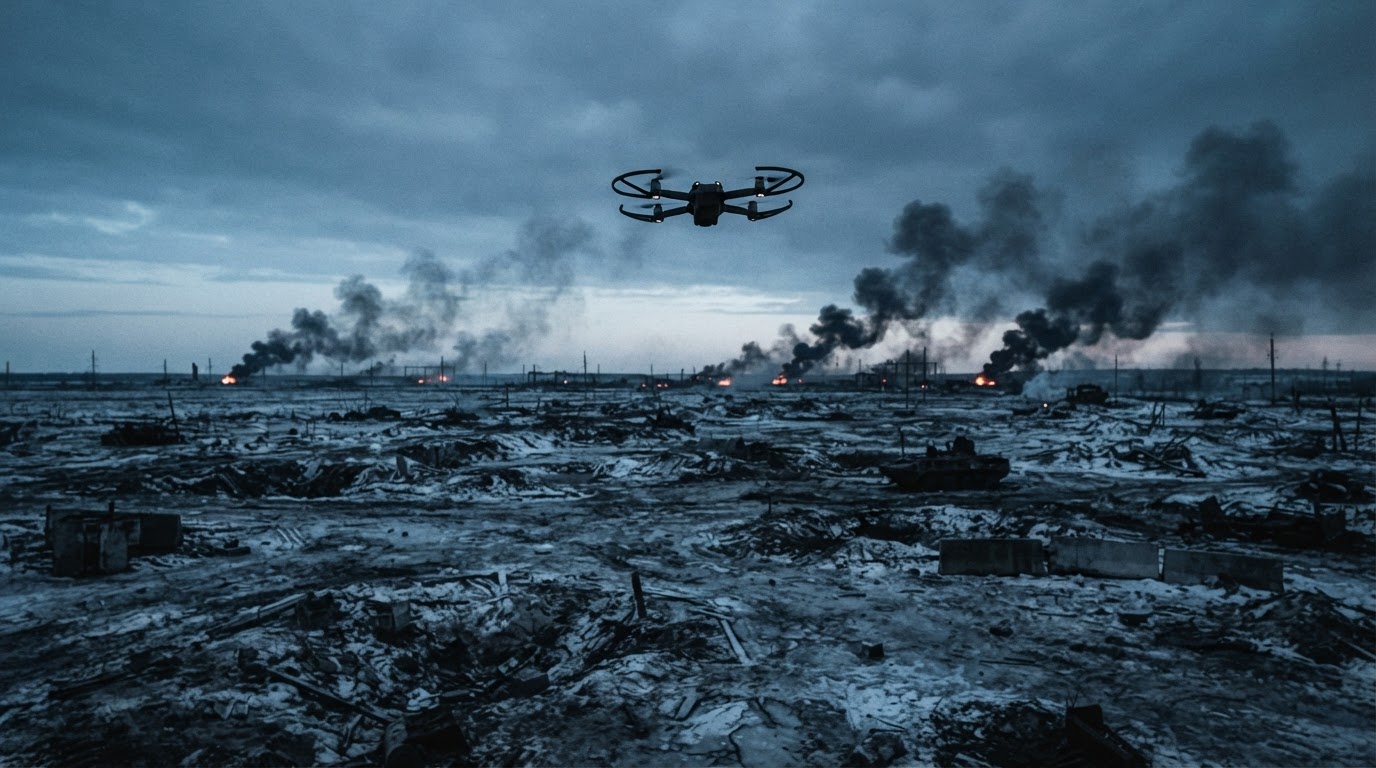
Outnumbered and outweighed in bodies, Ukraine substitutes machines for men. Cheap first-person-view drones now do the work of artillery, and increasingly they carry AI target-lock and terminal guidance that no longer relies on a human steering at the final second, partly because Russian jamming severs the link and partly because a machine is faster. The logic is hard to argue with from Kyiv’s side: a smaller nation keeping its people out of the meat grinder by sending robots instead. Who, watching a just defence, would tell them not to.
The fresh part: the war is becoming a dataset
Here is what is actually new, and what the decade-old killer-robot debate has not caught up to. Ukraine has begun opening its battlefield drone footage to allied firms, including companies in the United Kingdom, so they can train AI weapons on it. Every strike recorded, labelled and fed into models. The most intensely fought war in Europe since 1945 is quietly turning into the largest annotated training set for autonomous killing ever assembled, and it is being exported to the defence industries of friendly nations. The lessons of this war will not stay in this war.
And the rule-makers are a war too late
As the footage flows out, the Convention on Certain Conventional Weapons review conference is once again being pressed by Human Rights Watch, Amnesty and the Stop Killer Robots campaign to agree a mandate to negotiate binding rules on autonomous weapons. They have been pressing for roughly a decade. In that decade the technology stopped being hypothetical, got deployed, got proven, and started getting better by the month. You cannot write the rules of the road after everyone has already learned to drive without them.
The grim future, said plainly
Autonomy does not care whose cause is righteous. The moment a democracy fighting a just war normalises machines selecting and striking targets on their own, every other state inherits the same permission, including the nuclear-armed bullies this all started with. A cheap, scalable, deniable way to kill without risking your own people is precisely what a dictatorship dreams about. Ukraine’s necessity becomes everyone else’s template, and the aggressor gets to copy the homework of the victim.
What this means
Two things are true at once and you have to carry both. Ukraine is right to defend itself, and the method it has been forced into is a door that does not shut again once it is open. You can want Russia’s war machine broken, you can cheer every lost tank and every failed advance, and you can still be frightened of what is being built to do it. The villain in this war is not in doubt. The precedent being set is.
Edgar Friendly, calling the AI bullsh*t. More tools, more swearing: toptoolstack.com.
Did you know? A first-person-view attack drone can cost a few hundred dollars and destroy a tank worth several million. That ratio, more than any treaty, is why the machines are not going back in the box.
Sources: Novaya Gazeta Europe; The Moscow Times; Stars and Stripes; National Security Journal; DroneXL; Human Rights Watch.