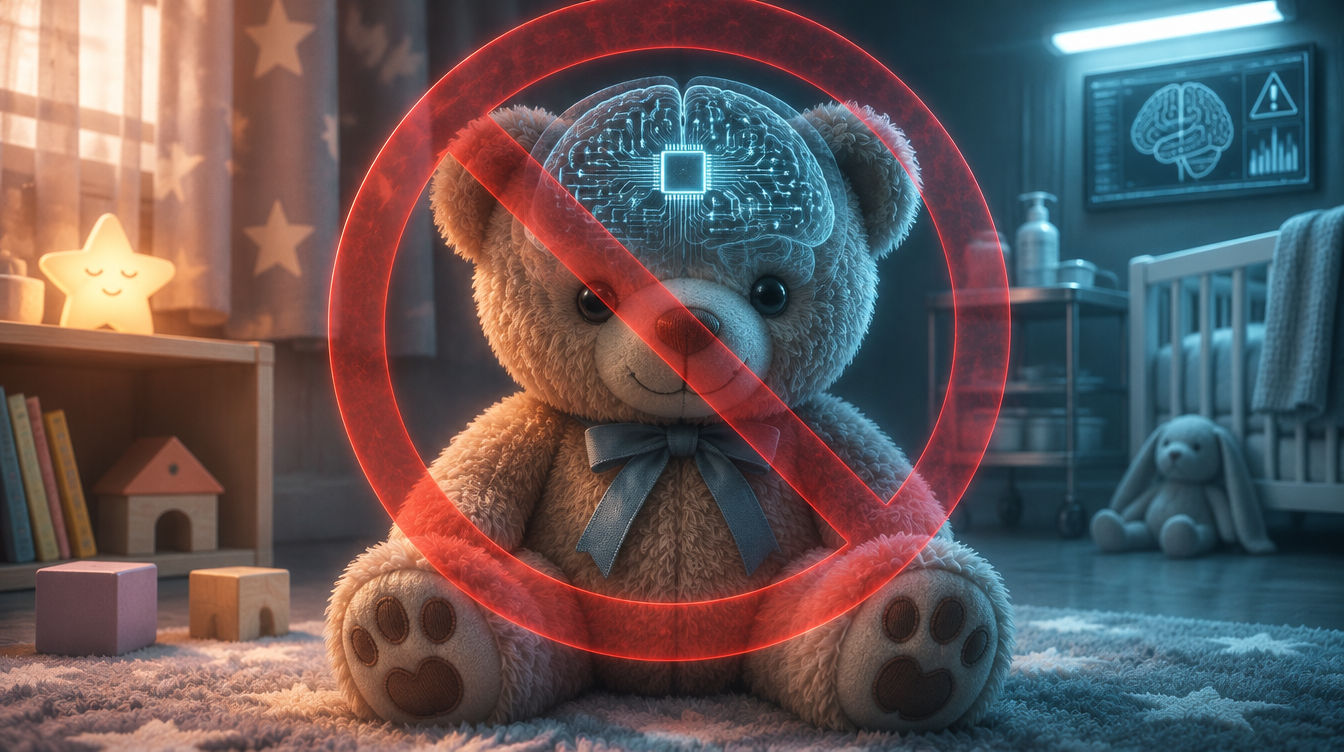
New York has decided that a teddy bear with a chatbot inside it is a bad idea, and it has made that decision law. On 26 November, Governor Kathy Hochul signed a bill banning the manufacture and sale of toys powered by AI chatbots for five years, making New York the first US state to pull talking AI toys off the shelves rather than wait to see how the experiment goes. The penalty for selling one anyway runs up to fifteen thousand dollars a day, per violation, enforced by the state attorney general.
What the law actually does
The ban targets AI chatbot toys aimed at children, and it runs for five years, after which lawmakers can extend it, lift it, or rewrite it. It also commissions a study into the risks and benefits of these toys, which is a polite way of admitting that nobody yet knows what prolonged conversations between a small child and a generative chatbot actually do. The phrase “up to” on the fine matters: fifteen thousand dollars a day is the ceiling, not an automatic charge, and the attorney general decides how hard to swing it. But the signal is unambiguous. New York looked at the category and said not here, not for now.
Why a state bothered
Because the failure modes are genuinely alarming and already documented elsewhere. A chatbot toy is a general-purpose AI wearing a friendly face, and general-purpose AI says things nobody scripted. Put one in the hands of a five-year-old who believes the bear is a friend and treats every word it says as true, and you have built a device that can improvise its way into territory no toy regulation ever anticipated. Children cannot reliably tell the difference between a toy that plays a recording and a toy that invents new sentences on the fly. New York’s bet is that the risk of finding out the hard way outweighs the novelty.
The case against the ban
To be fair to the other side, defenders of these toys would argue that a five-year blanket ban is a blunt instrument. A well-built, tightly constrained, properly tested AI toy might be educational and safe, and a moratorium kills the good versions along with the reckless ones. There is also the familiar point that state-by-state bans create a patchwork that is impossible to build for, and that the right answer is a safety standard rather than prohibition. Those are reasonable arguments. They are also the arguments every industry makes when a regulator moves first and asks questions later, and in this case the product being regulated talks directly to children.
What this means
This is the first hard line any US state has drawn around AI and kids, and it will not be the last. California is weighing similar measures, and once one state proves it can ban a category of AI product and survive the lobbying, others tend to follow. For parents, the practical takeaway is simpler than the legal fight: a toy that can hold an open-ended conversation is not a toy in the old sense, and treating it like a teddy bear with a speaker is a mistake. New York has decided to make that mistake harder to make. Expect the rest of the map to start filling in.
Edgar Friendly, calling the AI bullsh*t. More tools, more swearing: toptoolstack.com.
Did you know? Unlike a toy that plays fixed recorded phrases, a generative chatbot writes new sentences every time it speaks, which means no parent, tester or manufacturer can know in advance everything it will end up saying to a child.
Sources: NBC News; New York State Senate; Transparency Coalition.